The Trend Nobody Is Calculating the Cost Of
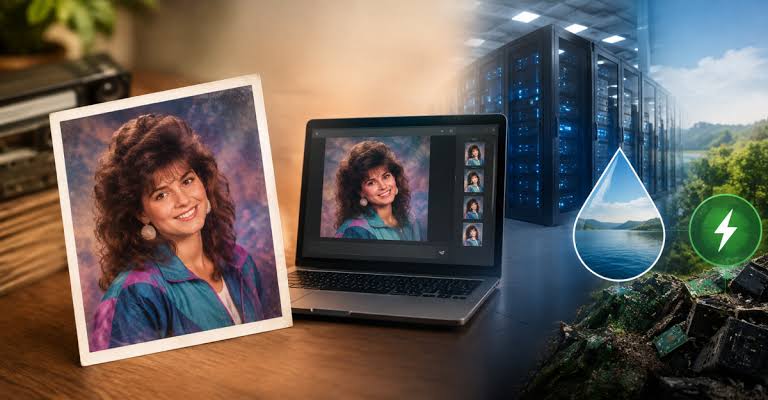
The 80s retro AI photo trend has taken India and global social media by storm in September 2026. Using tools like ChatGPT's image generation, Google's Imagen 3, and Meta's AI creative suite, millions are converting modern selfies into warm, grainy 1980s-aesthetic photographs. The results are charming. The environmental cost — electricity and water consumed by AI data centres — is far less discussed.

What Does One AI Image Cost?
- Electricity: Generating one high-resolution AI image consumes approximately 0.002–0.01 kWh. Small individually — but at 100 million daily global generations, that is up to 1 million kWh per day.
- Water: Data centres require cooling. Estimates suggest 0.5–1.5 litres of water per AI image — millions of litres daily at viral-trend scale.
Why India Should Care
India faces among the world's highest per-capita water stress. NITI Aayog data predicts 21 major cities could face groundwater exhaustion by 2030. Researchers at IIT Delhi and the National Institute of Advanced Studies (NIAS) have flagged the AI-water nexus as an under-regulated emerging concern — particularly as India's 800 million internet users become heavy AI consumers.
What AI Companies Say
Google, Microsoft Azure, and Meta all claim near-100% renewable energy matching for their data centres. Critics note that "renewable matching" does not mean off-grid operation — water cooling and grid drawdown remain realities regardless of energy sourcing. Transparency on water consumption is limited across all major AI providers.
Should You Stop?
No — individual usage impact is marginal. The concern is aggregate scale and corporate accountability. Think of it as nutritional labelling: the information should exist even if most consumers do not change behaviour based on it.
Key Takeaways
- Each AI image: 0.002–0.01 kWh electricity and ~0.5–1.5 litres water.
- At viral scale, aggregate daily water and energy use becomes significant.
- IIT Delhi and NIAS researchers flag the AI-water nexus as a policy gap.
- AI companies invest in renewables but water transparency remains limited.
Frequently Asked Questions
How much electricity does one AI image use?
Approximately 0.002–0.01 kWh per high-resolution image generation, depending on model size and data centre efficiency.
Is the 80s AI photo trend bad for the environment?
Individual usage has minimal impact. At population scale, aggregate energy and water use warrants greater transparency from AI companies.
Conclusion
Enjoy the retro selfies — but know what runs them. The 80s AI photo trend is fun and harmless for individuals. At national and global scale, it is one more reminder that AI's infrastructure cost is real, measurable, and significantly under-disclosed. India's scientists are right to start asking.